From facilitating mobile recharges to becoming a cornerstone of India’s digital economy, Paytm’s journey is a testament to strategic marketing and innovation. Here’s how the brand transformed “Paytm Karo” into a cultural phenomenon.
1. Humble Beginnings: Mobile Recharges to Digital Wallets
Founded in 2010 by Vijay Shekhar Sharma under One97 Communications, Paytm—short for “Pay Through Mobile”—began as a platform for mobile recharges. With an initial seed funding of $2 million, the company leveraged SEO, cost-per-click ads, and word-of-mouth to gain traction. As smartphone usage and 3G connectivity expanded in 2012-2013, Paytm introduced storytelling-driven advertisements, depicting relatable scenarios like sending money to a sibling during Rakhi or recharging a DTH connection mid-show.
In 2014, the launch of Paytm Wallet marked a significant shift. Marketing campaigns emphasized ease of use and cashback offers, tapping into India’s penchant for value-added deals.
2. Cricket: The Ultimate Marketing Pitch
Recognizing cricket’s unparalleled reach in India, Paytm made strategic investments to associate with the sport. A ₹203 crore deal to sponsor India’s international home matches was followed by securing the IPL title sponsorship from 2016 to 2019. During this period, Paytm’s branding was omnipresent—from toss graphics to trophies.
The company launched cricket-themed cashback campaigns, dominated in-stadium branding with LED boards and cheer squads, and served as a ticketing platform for teams like Delhi Capitals and Kings XI Punjab. Notably, the “Kisi Ki Life Ka Paytm Bano” campaign during IPL 2019 positioned Paytm as a technological enabler in everyday life.
With the surge in online gaming during the pandemic, Paytm introduced Paytm First Games, a fantasy sports platform, bringing cricket legend Sachin Tendulkar on board as its brand ambassador. A substantial marketing budget of ₹300 crore was allocated, with 50% earmarked for promotions during the IPL season.
3. Demonetisation: Seizing the Moment
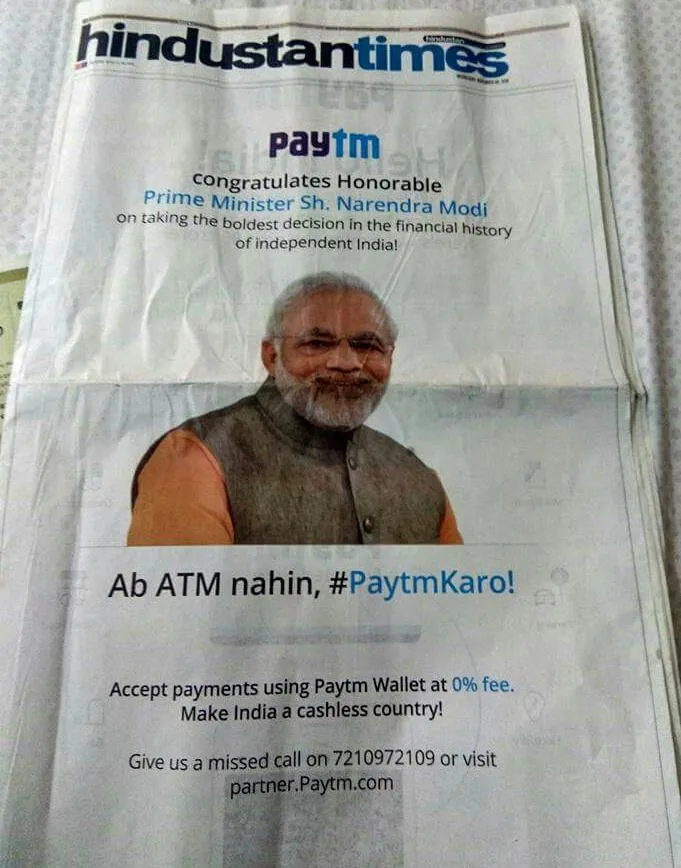
The 2016 demonetisation was a pivotal moment for digital payments in India. Within hours of the government’s announcement, Paytm rolled out a full-page newspaper ad featuring Prime Minister Modi’s photo, urging citizens to “Paytm Karo” as a solution to the cash crunch. Television commercials from that period were emotionally charged, addressing issues like corruption and promoting digital payments. This swift response positioned Paytm as a trustworthy alternative during financial uncertainty.
The impact was significant: Paytm’s user base surged from 125 million to 185 million within three months post-demonetisation. User traffic spiked by 435%, with a 250% increase in overall transactions and transaction value.
4. Diversification: Expanding the Ecosystem
Post-2017, Paytm diversified its offerings, introducing services like Paytm Mall, Paytm Money, insurance, ticketing, and gold investment. Marketing strategies were tailored accordingly:
- Paytm Money: Educational campaigns targeted first-time investors in Tier 2 and Tier 3 cities.
- Paytm Payments Bank: Emphasized trust, safety, and transparency with no hidden charges.
- Paytm Mall: Adopted strategies akin to e-commerce giants, focusing on mega sale events, app-only discounts, and influencer collaborations.
Despite varied messaging across verticals, the unifying call to action remained: “Paytm Karo.”
5. Soundbox: Crafting a Sonic Identity
In 2019, Paytm introduced the Soundbox—a device providing instant audio confirmation of payments. Initially rolled out quietly among small and mid-size merchants, it addressed challenges like SMS delays and payment disputes. The familiar chime, “Paytm pe ₹80 prapt hue,” became synonymous with successful transactions, embedding itself into the daily lives of users.The Hindu Business Line+3Paytm+3Business Today+3
By March 2023, over 6.8 million merchants subscribed to Paytm’s payment devices, including the Soundbox and Point-of-Sale systems. The device’s success prompted competitors like BharatPe and PhonePe to launch their versions, but Paytm maintained a significant lead in market penetration.Rest of World
6. Social Media: Engaging the Digital Audience
Paytm’s social media strategy blends financial education with pop culture. On Instagram, with over 4 million followers, the brand uses reels, carousels, and memes to explain topics like UPI limits, KYC, and QR frauds. The content often rides on current trends, from Bollywood releases to cricket tournaments.
On X (formerly Twitter), Paytm’s handle, boasting over 1.3 million followers, engages users with witty one-liners and timely responses to trending topics. YouTube serves as a repository for campaign videos, tutorials, and testimonials, catering to a diverse linguistic audience across India.
Conclusion: Building Trust Through Innovation
From simplifying mobile recharges to pioneering digital payments, Paytm’s journey reflects a deep understanding of India’s diverse consumer base. Through strategic marketing, timely innovations like the Soundbox, and a consistent brand message, Paytm has not only gained widespread adoption but also ingrained itself into the cultural fabric of the nation.